
Role of structural water molecules in slow inactivation of voltage-gated potassium channels
2021, August 11 - 11:30
Role of structural water molecules in slow inactivation of voltage-gated potassium channels
Role of structural water molecules in slow inactivation of voltage-gated potassium channels.
Tibor G Szanto, Gyorgy Panyi and their colleagues investigated the role of the structural water molecules in the stabilization of the selectivity filter in its inactive conformation in voltage-gated potassium channels (Kv) of the Shaker family. They employed the conventional patch clamp technique in whole-cell, inside-out and outside-out configuration using different Shaker constructs for studying the effect of heavy water (D2O) on the essential gating transitions, mainly focusing on the inactivation kinetics. They found that extracellular D2O dramatically slowed the entry into the slow inactivated state leading to a conclusion that the rate of structural water exchange at the region behind the selectivity filter determines the rate of slow inactivation, as proposed by molecular dynamic simulations. These results provide fine details about the role of not only the structural water molecules but the residues in the selectivity filter region that modulate structural water access. Slow inactivation, on one hand, essentially determines the fraction of channels available to open, which is critical for excitable cells. On the other hand, understanding the factors that regulate gating transitions of KV channels may aid the design of more efficacious drugs with state-dependent binding. These results are published in Journal of General Physiology (D1, IF: 3.628). DOI: 10.1085/jgp.202012742
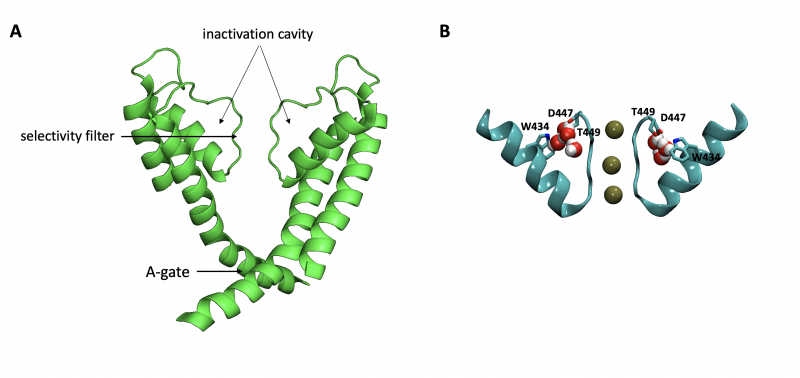
Figure. (A) Structure of the pore region of Shaker voltage-gated potassium channels. Two diagonally opposite subunits are shown as ribbon representations with front and rear subunits removed for clarity. The inactivation cavity involves an extended hydrogen bond network and structural H2O molecules controlling inactivation. (B) Detailed view of the selectivity filter and the pore-helix of two diagonally opposing subunits. Bound K+ ions in the selectivity filter (SF) and structural water molecules behind the SF are depicted. Residues that are involved in the regulation of the structural water transport into the inactivation cavity (W434, D447, and T449) are also illustrated in stick format.